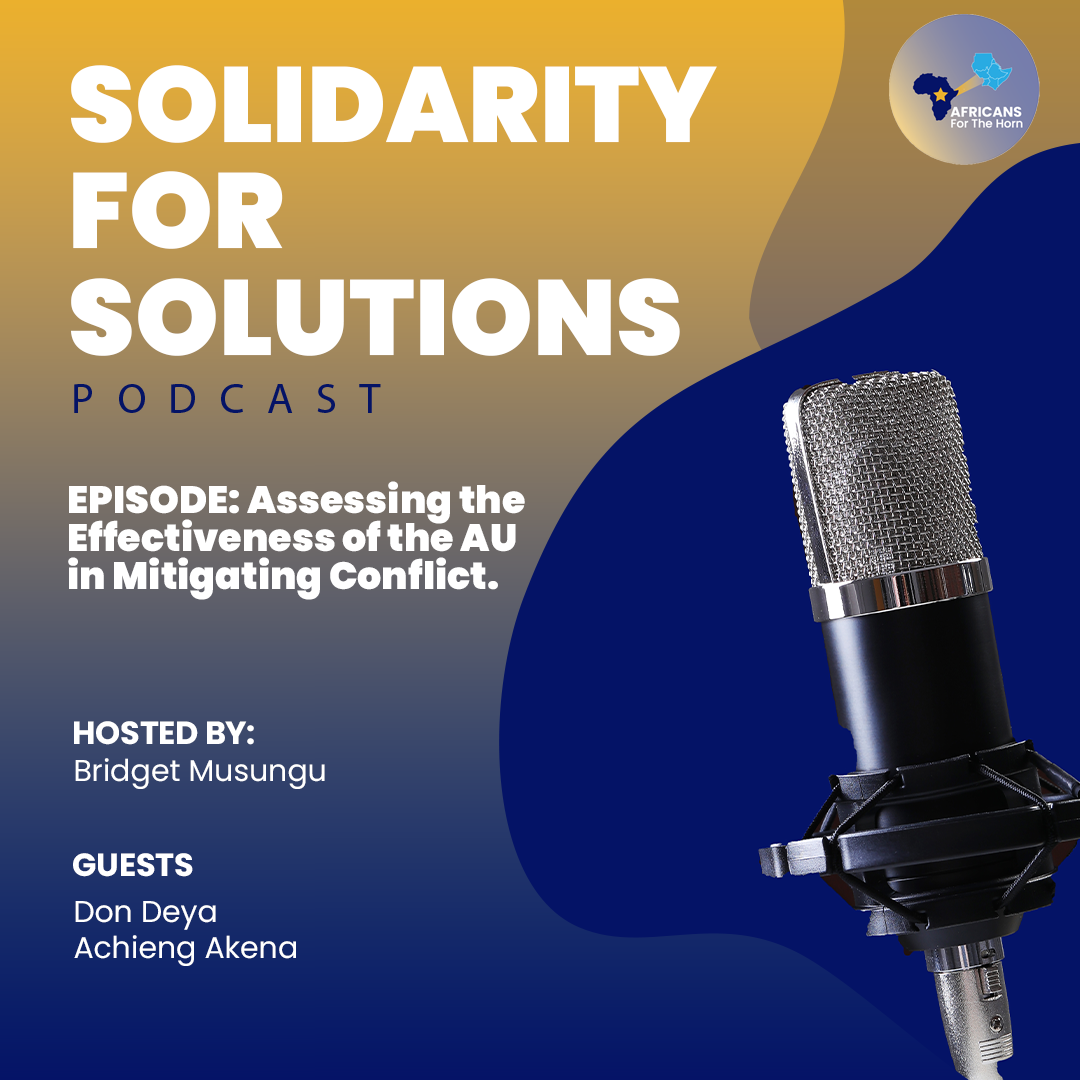
Solidarity For Solutions artwork
Business:Non-Profit

Solidarity For Solutions

AF Hosted by Africans for the Horn of Africa (Initiative) Af4HA

The Horn of Africa continues to be characterized by enduring conflicts and an ongoing threat of instability. Given the extraordinary and significant challenges to peace and security in Africa, it is time for a change of course in the way the Peace and Security Council operates. In this episode, Achieng Akena and Donald Deya provide their analysis of the historical performance of the African Peace and Security Council in resolving conflicts within the Horn of Africa, challenges faced by the Council in mitigating crimes in the Horn as well as its success. They also delved into the potential enhancement to the Council's strategies for more impactful conflict mitigation and initiatives by civil societies.

5 episodesIrregular

Episodes

5

South Sudan’s Postponed Elections: Reflections and the Path Forward

South Sudan has postponed its scheduled elections initially set for December 2024 for 24 months to 2026. The government cited a lack of preparedness and opportunity to implement key provisions of the Revitalised Agreement on the Resolution of the Conflict in South Sudan (R-ARCCSS) including the drafting of a permanent constitution, the establishment of functional and adequately funded electoral institutions, political party registration, the unification of security forces, and the guarantee of safety for all citizens. The delay in the democratic process casts uncertainty over the country’s democratic transition, posing risks to both peace and stability. Without a definitive path toward democratic governance, South Sudan faces a heightened risk of regression into conflict, as the lack of a legitimate and stable government could lead to escalated violence and destabilization from competing factions. Despite the election postponement, it remains uncertain if the necessary conditions will be met by December 2026. It is therefore crucial that the Revitalized Transitional Government of National Unity (R-TGoNU), established to restore hope for peace, stability, and prosperity, takes decisive steps to set South Sudan on a sustainable path toward democratic transition and end the repeated cycle of election delays. In this episode we re-evaluate South Sudan’s future amidst the current instability, exploring solutions to navigate the challenges of delayed elections and uncertain democratic transition, and ultimately seeking pathways to peace and stability.
2 years ago27 min
4

Sudan’s Humanitarian Crisis: Mutual Aid and International Action

In the face of ongoing brutal violence and atrocities, Sudan now teeters on the brink of a full-blown humanitarian catastrophe. The conflict, already recognised as one of the world's worst humanitarian crises. Despite the escalating humanitarian crises, hopes for an imminent resolution to the war reportedly remain slim. The ongoing violence has drastically limited humanitarian access, with international aid efforts being hampered by ongoing fighting and blockades, leaving millions of civilians, particularly women and children, in desperate need. In response, local initiatives like the Emergency Response Room (ERR) have emerged as a critical lifeline, filling the gap left by international organizations. Youth-led volunteer networks have established Emergency Response Rooms (ERRs) across the country, building on the national culture of nafeer, or mutual aid. The ERRs offer shelter to displaced people, support hospitals, and ensure access to food and water. ERR members have shown remarkable courage and compassion, risking their own safety to assist those in need. Their efforts have been crucial in delivering food, water, shelter, and medical care, alleviating the spread of famine, disease, and suffering amidst the crisis. In this episode, we explore the current humanitarian situation in Sudan, focusing on the crucial role played by grassroots initiatives like the ERR, why their efforts must be complemented by coordinated international action, and how this can be done. We will discuss how the international community can better support these local response mechanisms to ensure aid reaches those most in need.

2 years ago36 min
3

Why Peace in Sudan is Critical

For over 17 months, Sudan has been plunged into conflict and uncertainty. The conflict continues to inflict immeasurable death and suffering, displacing millions from their homes, and humanitarian crisis. Over ten million people have fled their homes since the conflict broke out in April 2023. With an estimated eight million of them remaining within Sudan’s borders, Sudan is now the world’s largest internal displacement crisis. Famine has been declared in parts of Sudan and looms over much of the rest of the country. Half of Sudan’s population is now suffering from acute hunger and five million children and pregnant and breastfeeding women are acutely malnourished. In this episode of Solidarity For Solutions, a podcast by the Africans for the Horn of Africa (Af4HA) Initiative, Bridget Musungu, a researcher at Af4HA, engages in a conversation with Kholood Khair, a Sudanese political analyst and founding director of Confluence Advisory, and Dr. Edgar Githua, an expert in international affairs, peace, and security to discuss why the international community must step up for Sudan and how it can do so.

2 years ago29 min
2

Enhancing women's participation in peace and security in the Horn of Africa

Check out Episode 2 of Solidarity For Solutions. Conflict and instability have long plagued the Horn of Africa, affecting millions of lives. During armed conflict women and girls are disproportionately affected. They are at a heightened risk for sexual violence, displacement, and loss of livelihoods. Conflict exacerbates existing vulnerabilities, disrupts livelihoods, affecting majority of women who engage in informal sectors. The displacement and destruction of infrastructure caused by conflict further strains women’s economic participation. Additionally, conflict-related stress, trauma, and limited access to healthcare disproportionately affects women, placing their maternal health, reproductive rights, and mental well-being at risk. Amidst these challenges, women play a crucial role in peacebuilding, conflict resolution, and community resilience. However, their contributions often go unrecognized and underutilized. Despite cultural and structural barriers, women have been active agents of change. While there are frameworks that acknowledge the importance of women's participation, the implementation often falls short of expectations. This podcast explores the existing mechanisms that can empower women and enhance their participation in peace and security efforts across the region.

2 years ago27 min
1

Assessing the Effectiveness of the AU in Mitigating Conflict

In this episode, Achieng Akena and Donald Deya provide their analysis of the historical performance of the African Peace and Security Council in resolving conflicts within the Horn of Africa, challenges faced by the Council in mitigating crimes in the Horn as well as its success. They also delved into the potential enhancement to the Council's strategies for more impactful conflict mitigation and initiatives by civil societies.

3 years ago52 min
0:00
0:00