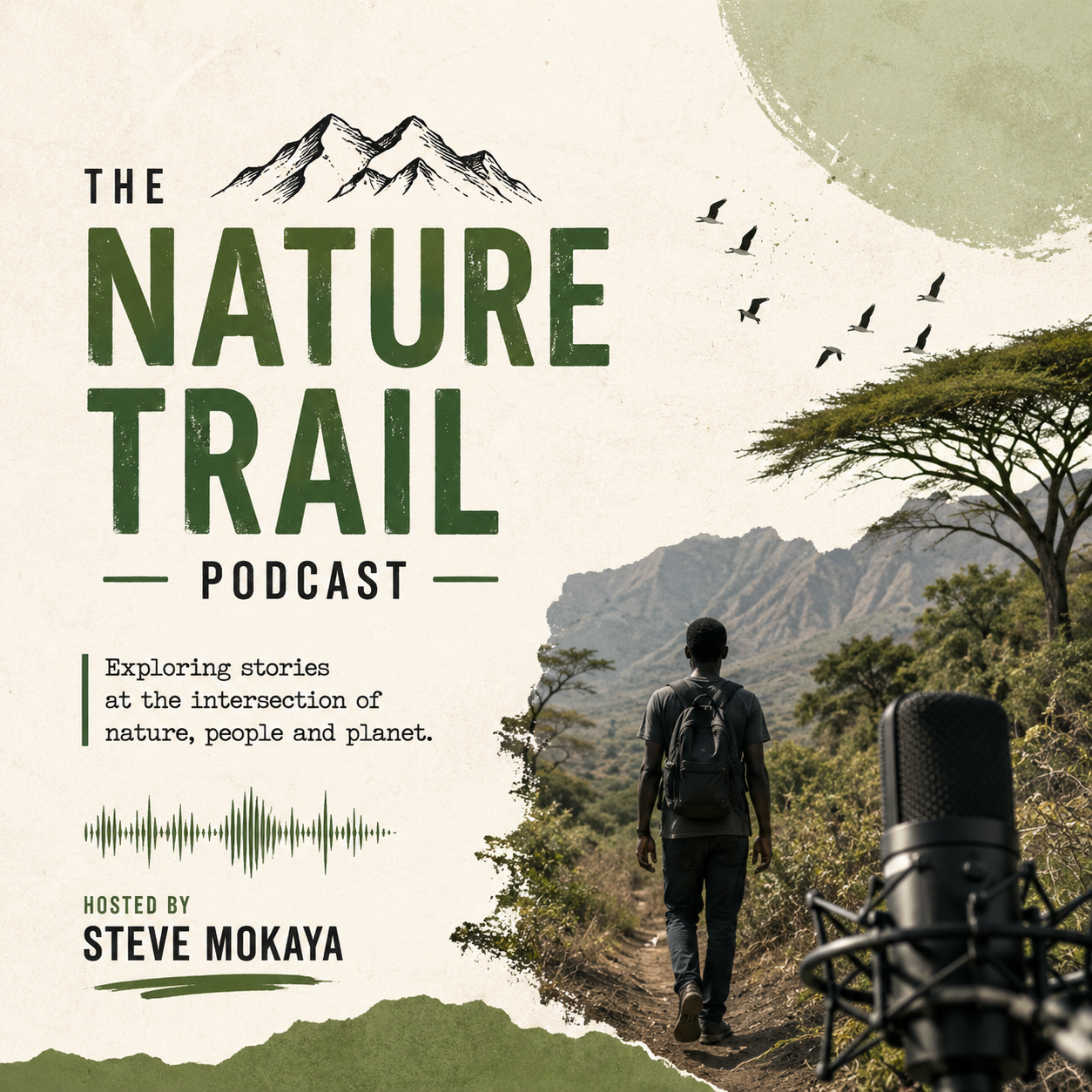
The Nature Trail Podcast artwork
Science:Life Sciences

The Nature Trail Podcast

SM Hosted by Steve Mokaya

Welcome to the Nature Trails podcast, where we explore the science, environment, climate change, and human interest stories of Kenya and around the globe. I'll take you on a journey to learn about the amazing natural world that surrounds us. We'll meet scientists and researchers who are working to understand and protect our planet. We'll hear from people who are making a difference in the fight against climate change. And we'll share stories of human connection with nature that will inspire you to get outside and explore. So come along! I'm your host, Steve Mokaya.

59 episodesMonthly

Episodes

The Cork Oak Is for My Grandson

Portugal is home to the largest cork forest on Earth. A single estate just outside Lisbon holds more of it, under one owner, than anywhere else in the world; the size of Washington DC. Trees whose bark won't be ready to harvest for fifty years. The land around it is one of roughly three dozen places on the planet ecologists call a biodiversity hotspot. In this episode, Steve Mokaya goes inside Companhia das Lezírias, 18,000 hectares of man-made ecosystem, with biologist Sandra Alcobia, to decode what this land demands of the people who run it. There's a lot interesting facts in this biodiversity concurcopia. A horse worth over a million euros that's never once allowed to mate on its own. Cork peeled like fruit, and left alone for half a century after. Tree roots that share water with each other underground. And a squirrel extinct here for five hundred years, just returned back. Some of what gets planted here will never be harvested by the people planting it, but by a grandson they'll never meet.


4 months ago27 min

The Afterlife of Coal

The mines that once powered the Ruhr Valley in Western Germany have fallen silent. Tourists now wander through places where miners once descended deep underground. The skies are cleaner, the rivers healthier, and the region has reinvented itself for a new era. Yet beneath the surface, the past has not entirely let go. In The Afterlife of Coal episode, Steve Mokaya travels through the Ruhr Valley to explore what happens when an industry that shaped generations disappears, and why its legacy continues to echo long after the last shift ends.

4 months ago28 min

Before the Fever Comes the Harvest

A failed harvest and a crowded clinic may seem like separate stories. But what if they are connected? In this episode, Steve Mokaya speaks with AMREF Health Africa's Friday Piri about the hidden links between climate change, food systems, nutrition and public health; and why Africa is already living many of the realities the world is only beginning to discuss.

5 months ago29 min

Climate Change, Pollination & the Future of Food

How does climate change affect pollination? What happens when heat stress interferes with plant reproduction? And why are scientists increasingly studying pollen as they search for more resilient crops? Recorded at the 2026 World Seed Congress in Lisbon by Steve Mokaya, this episode explores the science behind food production and the future of global agriculture.

5 months ago28 min

Africa's Food Future Depends on Technology, And Its Youth | Yacouba Diallo

Most young Africans do not dream of working in agriculture. Yet at the World Seed Congress in Lisbon, farming looked less like an industry rooted in tradition and more like one being transformed by artificial intelligence, biotechnology, drones and data. In this episode Steve Mokaya speaks with Yacouba Diallo, Secretary General of the African Seed Trade Association, about the future of African agriculture, the debate around GMOs, climate resilience, youth participation in farming, seed innovation and the opportunities emerging at the intersection of food and technology. This conversation explores what it will take for Africa to feed itself, and thrive, in a rapidly changing world.

5 months ago35 min

The Latitude Paradox: The North Warms & Africa Cools the Planet

Is the global reforestation rush actually making the planet hotter? Steve Mokaya investigates a groundbreaking ETH Zurich study that reveals that while forests in the snowy North can actually trap heat, Africa’s tropical belt is the world’s most powerful cooling engine. Host Steve Mokaya and researcher Nora Fahrenbach break down why location, not just the number of trees, is the deciding factor in our climate future. We explore "forest farming" as a solution for rural economies and why the North may need to pay for the air Africa cleans.

7 months ago15 min

The Return of Indigenous Seeds & Murang'a Path to Food Security

The rains delayed. Then they disappeared. In Kandara, Murang’a County, farmers watched maize dry up and beans fail, until some remembered the seeds their grandparents once planted. In this episode, Steve Mokaya traces how indigenous crops, once dismissed as old-fashioned, became lifelines during drought. At the heart of the story is a community seed bank built on trust, where farmers borrow seeds and return double, preserving biodiversity, protecting nutrition, and reclaiming control over their food future.

9 months ago18 min

How Empowering Women & Agroecology Can Fix Our Food System

In this episode, Steve Mokaya sits down with Chrispus Kinyua, founder of the Institute for Food Justice and Development (IFJAD), to unpack the hidden inequalities shaping our food systems. From women who grow food but lack land rights, to rural families facing climate shocks, nutrition gaps, and market barriers, this conversation explores why hunger persists where food is produced, and what it will take to build fairer, more resilient systems for farmers, food workers, and communities alike.

9 months ago15 min

How Tharaka Nithi's Women & Goats Are Outsmarting Climate Change

In rural eastern Kenya, milk is not always guaranteed. So women in Tharaka Nithi chose dairy goats as a solution. In this episode, Steve Mokaya explores how Umoja Self Help Group has used small livestock to improve nutrition, build consistent income, and strengthen women’s economic agency, offering a grounded look at how gender, climate adaptation, and everyday survival intersect.

9 months ago18 min

Transforming Makueni: Gender, Climate & Conservation Agriculture

Makueni County is no stranger to drought and food insecurity. But across its villages, farmers, many of them women, are reshaping the future of their land through minimum tillage, cover cropping, and indigenous seed systems. In this episode, Steve Mokaya reports on how conservation agriculture, supported by the African Conservation Tillage Network, is rebuilding soil health, strengthening nutrition, and shifting long-held cultural norms around land and decision-making.

9 months ago20 min
0:00
0:00